Home
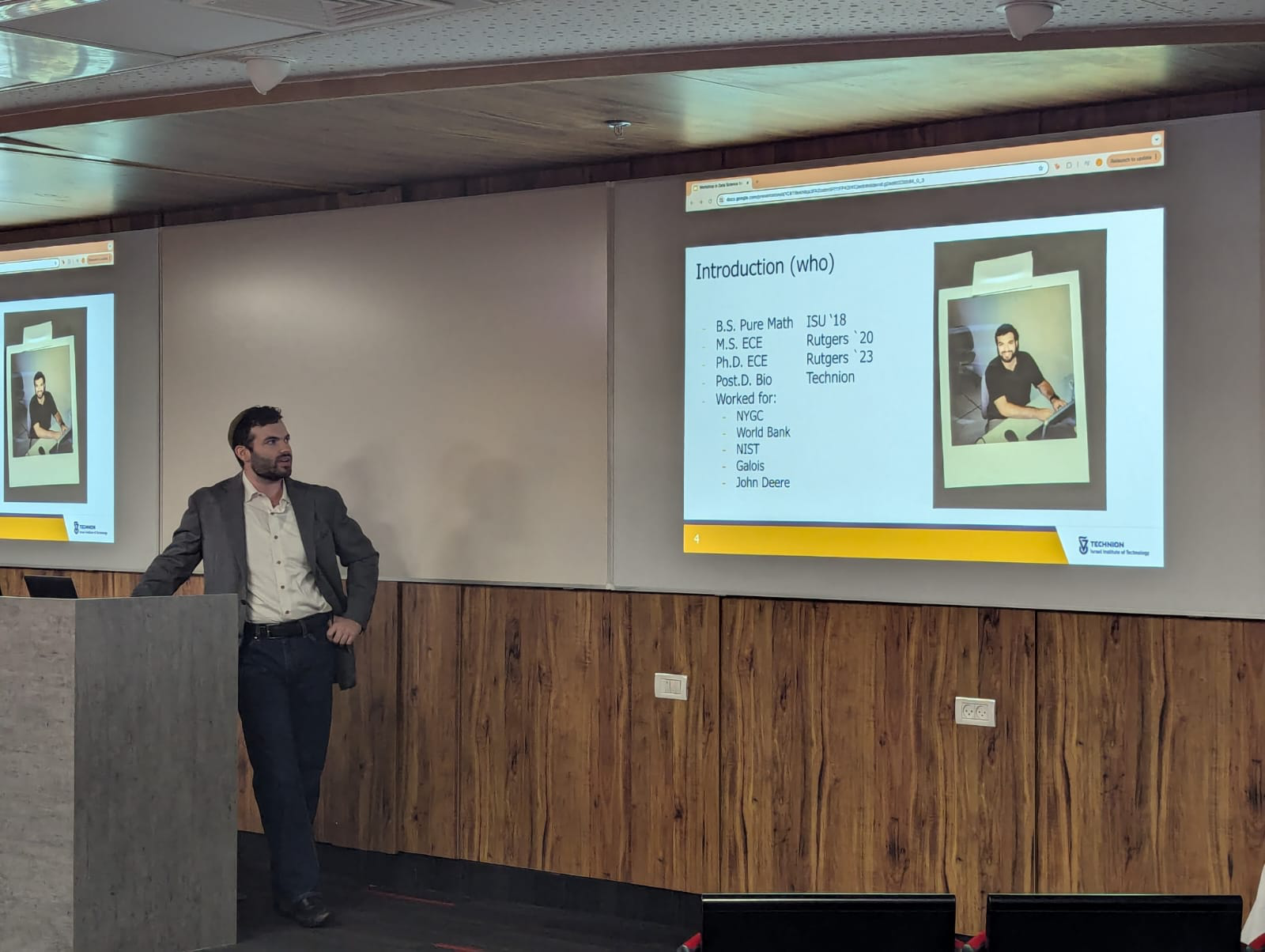
I am a researcher working on appling data science and engineering techniques to real world problems in biomedicine. I recieved my B.S. in pure mathematics from Iowa State University with a dual emphasis in discrete logic and applied computations in May 2016 under Dr. Krister Lee. I finished my M.S. in electrical and computer engineering with an emphasis in cyber security in Jan 2021 under Dr. Saman Zonouz. I got my Ph.D. in electrical and computer engineering with an emphasis in artificial intelligence in June 2023 under Dr. Saman Zonouz and Dr. Eric Davis.
My research focuses on advancing machine learning through acceleration, optimization, and personalization, with a strong emphasis on applying data-driven methods to complex scientific domains such as genomics, proteomics, and broader biological sciences. I develop biomimicry-inspired algorithms, explore ontological learning and symbiotic intelligence, and leverage high-performance and parallel computing to push the limits of applied ML, with a focus on on-device training and optimization. My work also extends to single-cell RNA-seq analysis and quality assurance, integrating discrete mathematics and graph theory to build more robust, interpretable, and efficient computational systems.
About
I began my academic journey in theoretical mathematics at Iowa State University in 2016. There I immersed myself in cybersecurity competitions, especially cryptography, which strengthened my analytical mindset and sparked my fascination with real-world computational challenges. That curiosity quickly grew into a love for programming and data science, which led me to industry roles early on.
I worked at Kingland Systems as a cognitive research engineer developing financial regulation technologies, contributed to MNIST on a project building a research database for stenography, and joined Trustworthy Labs as an undergraduate researcher uncovering hidden relationships in the Paradise Papers.
After completing my B.S. in 2018, I continued at Iowa State to begin a Ph.D. in computer science. My focus was on large-scale data modeling, which also allowed me to serve as a research scientist at John Deere tackling big-data problems in agriculture. My work led me to Dr. Saman Zonouz at Rutgers, who invited me to join his lab, 4N6, where I specialized in cyber-physical security (CPS) for biomedical devices. During my time at Rutgers, I received the NSF GAANN Fellowship, collaborated with the New York Genome Center on CRISPR-Cas13 modeling, and created and led the “Capture the Drone” competition to teach undergraduates core security concepts.
I completed my master’s during the COVID-19 pandemic in 2021 and gradually shifted my research focus from CPS to biological modeling and biomimicry. This transition allowed me to explore brain-inspired approaches to machine learning and alternative learning mechanisms for AI. I completed my thesis, centered on making AI more accessible, under the guidance of Dr. Zonouz and Dr. Eric Davis in 2023.
Eventually, I realized that AI is most meaningful when deeply connected to real scientific applications. This insight brought me to the Technion, where I joined Dr. Dvir Aran’s lab and expanded my work into biology, particularly single-cell analysis and cellular fate modeling. Alongside my research, I run the lab’s HPC infrastructure, teach, and continue integrating into life and science in Israel.
Contact
For research related inquiries, please email jbingham[at]campus.technion.ac.il
For all other inquiries, please email joebingham[at]me.com
Google Scholar - https://scholar.google.com/citations?user=OQWMUEkAAAAJ&hl
ORCID - https://orcid.org/0000-0001-6716-6468
Github - https://github.com/JosephBingham/
LinkedIn - https://www.linkedin.com/in/joseph-bingham-b63363155/
CV
Publications
CV
Teaching
Courses I've Taught
-
001380501 Selected Topics in Data Science for Biological and Medical Applications
Institution: Technion University
Duration: Semester B 2025
Description:I designed a course from scratch that engaged students across disciplines, spanning from biology and chemistry to computer science. This course was later expanded due to its impact and demand, at the dean’s request. The course introduces intersectional concepts in an accessible way, and culminates in a final presentation. The final project has the students apply what they’ve learned to analyze and model data from their own research. I taught students with no programming background to implement complex models in Python using a range of packages and environments, and I served as the full lecturer, coordinating students, teaching assistants, and administrative staff to ensure strong learning outcomes.
-
00138029 Advanced Topics in Data Science for Biological and Medical Applications
Institution: Technion University
Duration: Semester B 2024
Description: I designed a course from scratch that effectively engaged a diverse student body, spanning from pure biology and chemistry to computer science, by teaching intersectional concepts in an accessible and compelling way. I taught students with no prior programming experience to implement complex models in Python using a variety of packages and environments, and I served as the full lecturer, coordinating students, teaching assistants, and administrative staff to ensure that all learning objectives were met.
-
16 332 579 Advanced Topics in Computer Engineering
Institution: Rutgers University
Duration: Spring Semester 2019
Description: Learn and apply the fundamental principles of dissecting malware, vulnerability finding/defense, and cyber attack triage Become aware of limitations of existing defense mechanisms and how to avoid them Study cutting-edge research publications on these topics Engage in critical discussion around key research topics in software security and forensics Propose solutions to open-ended research problems and implement novel prototype solutions.
-
COM S 230/330 Discrete Computational Structures
Institution: Iowa State University
Duration: Fall Semester 2018
Description: Concepts in discrete mathematics as applied to computer science. Logic, set theory, functions, relations, combinatorics, discrete probability, graph theory and number theory. Proof techniques, induction and recursion.